Tunable THz Smith-Purcell Radiation is a new research attraction.
How Smith-Purcell Radiation Occurs?
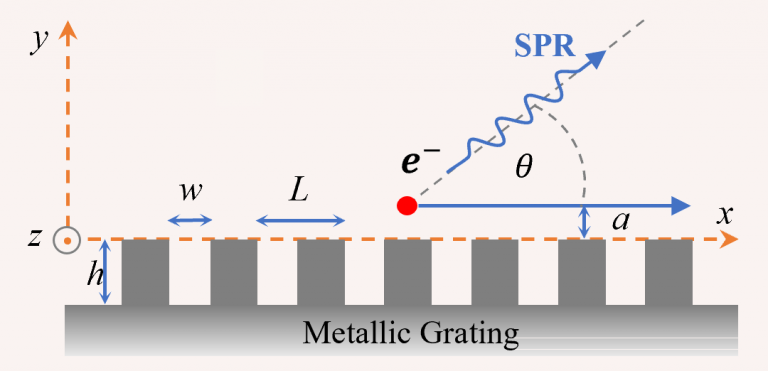
Since its discovery in 1953, Smith-Purcell Radiation (SPR) has been a topic of interest for scientists and researchers [1]. SPR occurs when an electron beam passes over a periodic metallic grating, and it has been observed in a wide range of frequencies, from visible light to Tera Hertz (THz) waves. With the recent development of low-cost and powerful THz electromagnetic wave generators, SPR in the THz range has become a new research attraction.
Recent research on Smith-Purcell Radiation
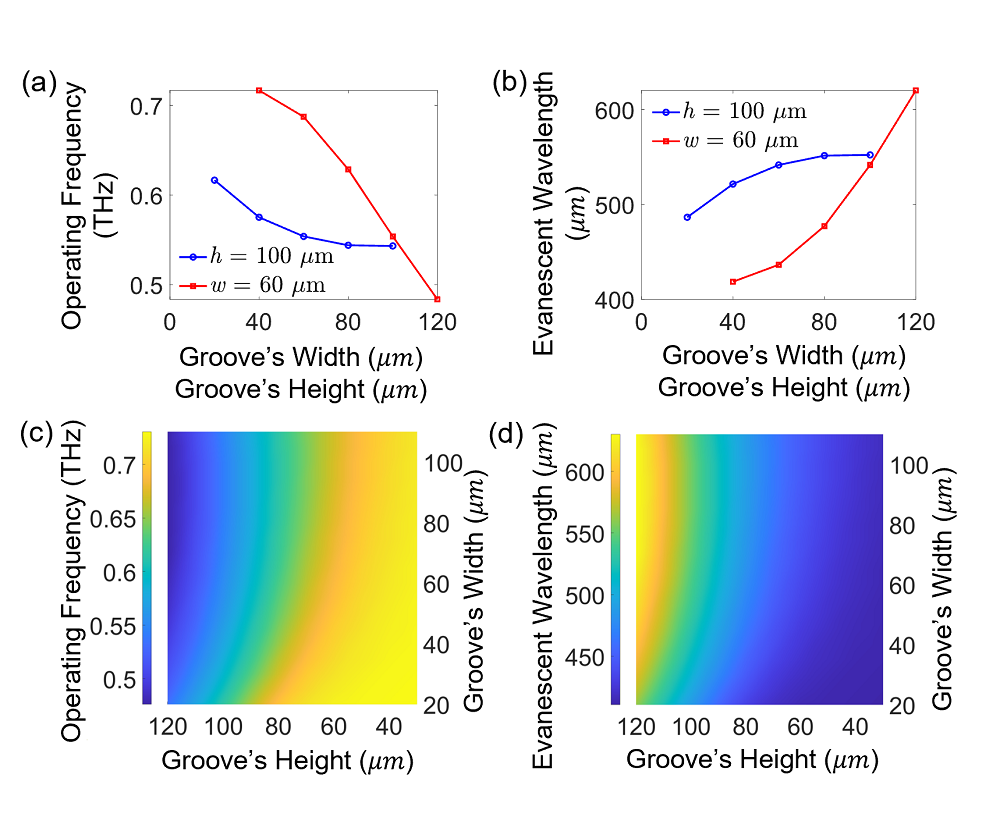
In a recent article published in the IEEE Transactions on Electron Devices, Md Arifuzzaman Faisal and Peng Zhang explore the optimization of SPR for THz frequencies through the tuning of the grating parameters [2]. Using dispersion relations, the authors investigate the correlation between the grating groove’s width and height and the operating frequency of coherent SPR. They show that the operating frequency at the evanescent wave frequency varies significantly with the change in the grating groove’s width and height. They keep a fixed high-energy electron beam and the grating period during this analysis.
The authors also demonstrate that the spatial growth rate of SPR is directly correlated with the starting current. By optimizing the grating parameters, they were able to increase the spatial growth rate and enhance the SPR output power. This result suggests that the grating design is a critical factor in achieving tunable and efficient THz SPR.
Terahertz radiation application
The ability to generate tunable THz SPR has important implications for a range of applications, including medical imaging, spectroscopy, and communication. For example, THz waves can penetrate through non-metallic materials, such as plastics and clothing, making them ideal for non-invasive medical imaging. Moreover, THz waves can be used for high-speed communication, as they have a high data transfer rate and can transmit through atmospheric conditions that can interfere with traditional radio waves.

Fig. 2. The cold-tube dispersion relation (Eqn. (2)) for (a) different groove’s height h where groove’s width w is fixed at 60 μm, (b) different w where h is fixed at 100 μm, and other parameters are kept as the same as in Table I. The yellow dots denote the operation points at the evanescent wave frequency f_ev. [2]
In conclusion, the optimization of SPR for THz frequencies through the tuning of the grating parameters is a promising area of research that can lead to the development of low-cost and powerful THz electromagnetic wave generators. The ability to generate tunable THz SPR has the potential to revolutionize a range of applications, from medical imaging to high-speed communication, and will undoubtedly continue to attract the attention of scientists and researchers in the coming years.
References:
[1] S. J. Smith and E. M. Purcell, “Visible Light from Localized Surface Charges Moving across a Grating,” Phys. Rev., vol. 92, no. 4, pp. 1069–1069, Nov. 1953, doi: 10.1103/PhysRev.92.1069.
[2] Md Arifuzzaman Faisal and Peng Zhang. “Grating Optimization for Smith–Purcell Radiation: Direct Correlation between Spatial Growth Rate and Starting Current.” IEEE Transactions on Electron Devices, 2022, doi:10.1109/ted.2022.3208846.
Read more about Tunable Tera Hertz (THz) Frequency from Smith-Purcell Radiation –
Journal Article: Grating Optimization for Smith–Purcell Radiation: Direct Correlation Between Spatial Growth Rate and Starting Current
Author: Md Arifuzzaman Faisal ; Peng Zhang
Publisher: IEEE Transactions on Electron Devices (Impact Factor: 3.221)
Publication date: 10 October, 2022
Doi: 10.1109/TED.2022.3208846 (To read this journal article, click here)