Minimizing Starting Current of Smith–Purcell Radiation
Journal Article: Grating Optimization for Smith–Purcell Radiation: Direct Correlation Between Spatial Growth Rate and Starting Current
Author: Md Arifuzzaman Faisal ; Peng Zhang
Publisher: IEEE Transactions on Electron Devices (Impact Factor: 3.221)
Publication date: 10 October, 2022
Doi: 10.1109/TED.2022.3208846 (To read this journal article, click here)
Abstract
Smith–Purcell radiation (SPR) is generated when electrons travel close to a metallic periodic grating. It was found that the starting current of SPR varies by orders of magnitude by simply varying the grating parameters (groove’s heights and widths) while keeping the grating period and the electron beam properties fixed. In this article, we demonstrate that this strong dependence of starting current on the grating parameters is directly related to the spatial growth rate of the SPR. Using the hot-tube dispersion relation, we optimize the grating parameters to minimize the starting current to excite coherent SPR.

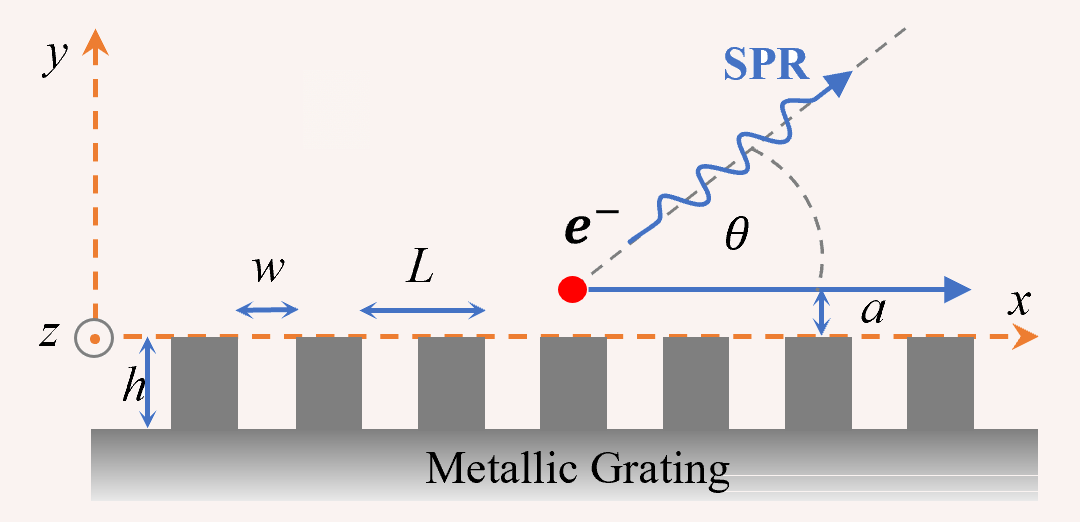
Fig. 1. Schematic of Smith–Purcell grating and beam configuration.
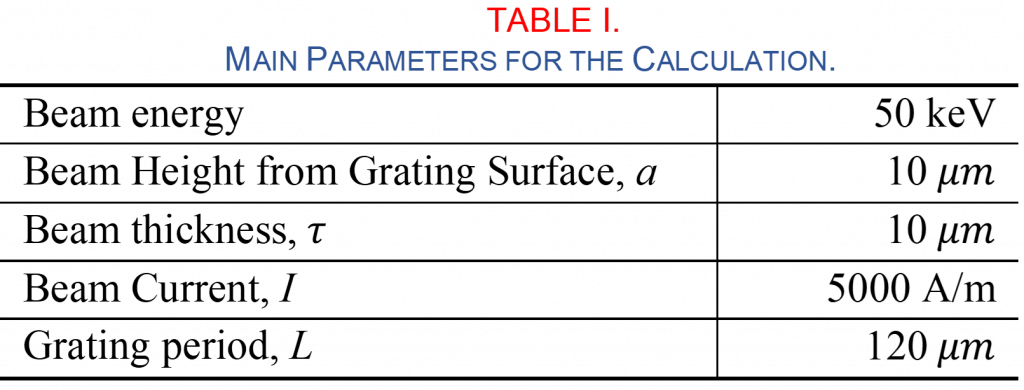
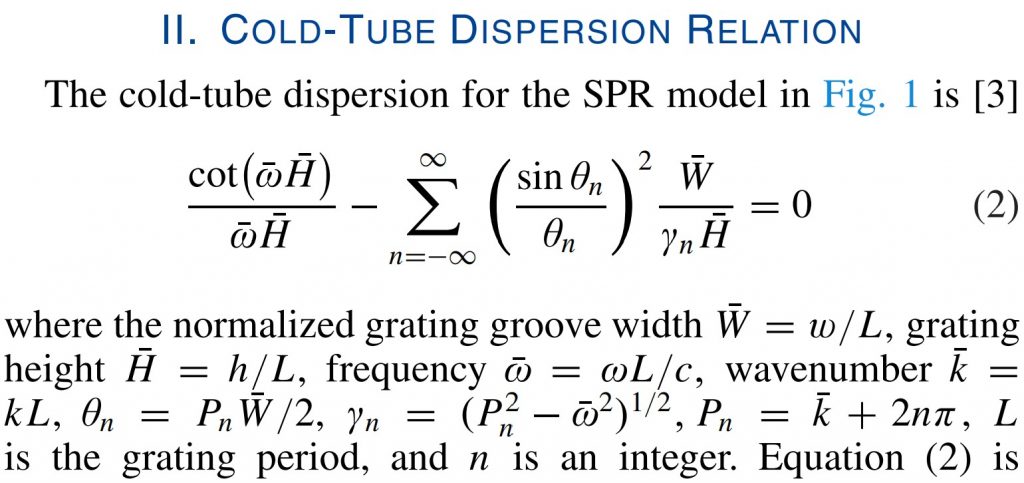

Fig. 2. The cold-tube dispersion relation (Eqn. (2)) for (a) different groove’s height h where groove’s width w is fixed at 60 μm, (b) different w where h is fixed at 100 μm, and other parameters are kept as the same as in Table I. The yellow dots denote the operation points at the evanescent wave frequency f_ev.
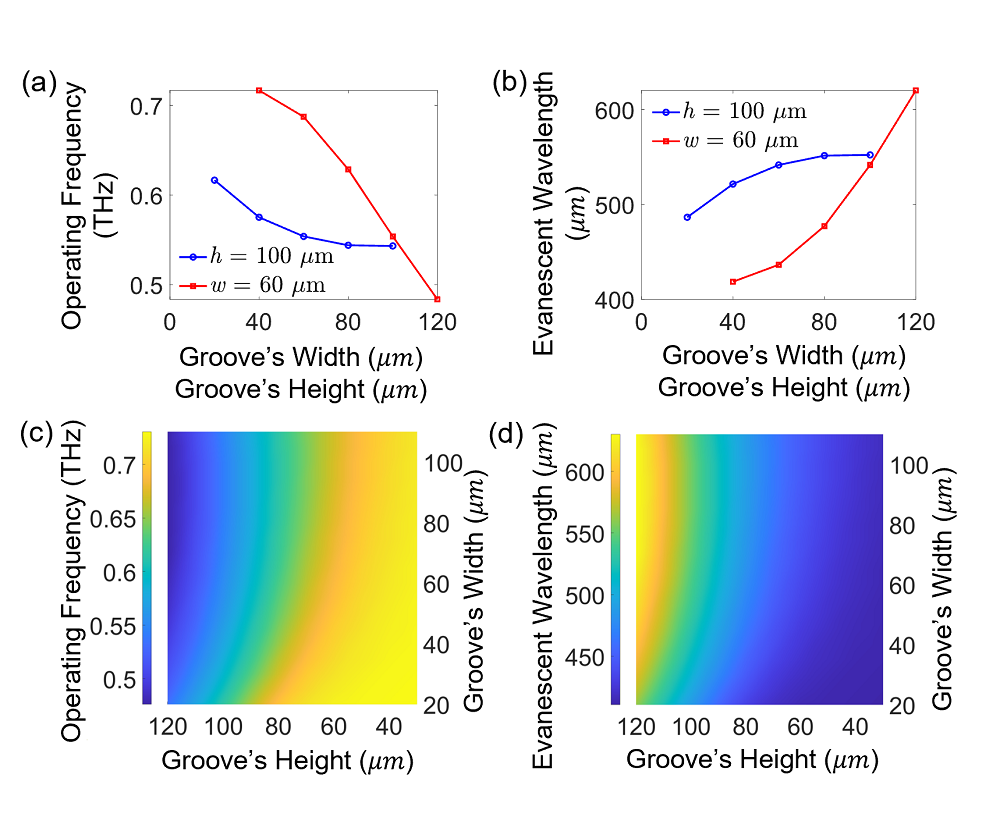
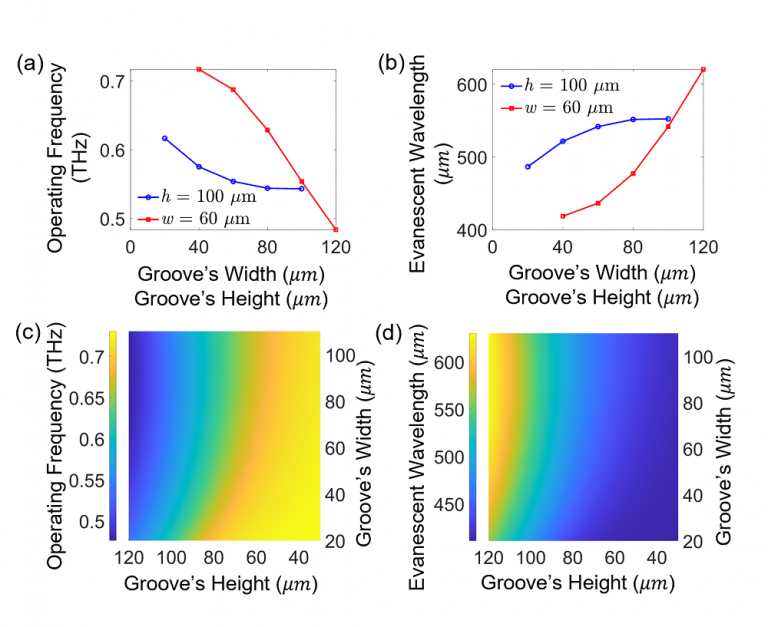
Fig. 3. (a) The operating frequency (f_ev) and (b) the corresponding evanescent wavelength (λ_ev) as a function of grating groove’s height and width, for Fig. 2(a) [red line] and 2(b) [blue line] [3]. The surface plot of (c) f_ev and (d) λ_ev for a wide range of groove’s heights and widths, with other parameters in Table I.
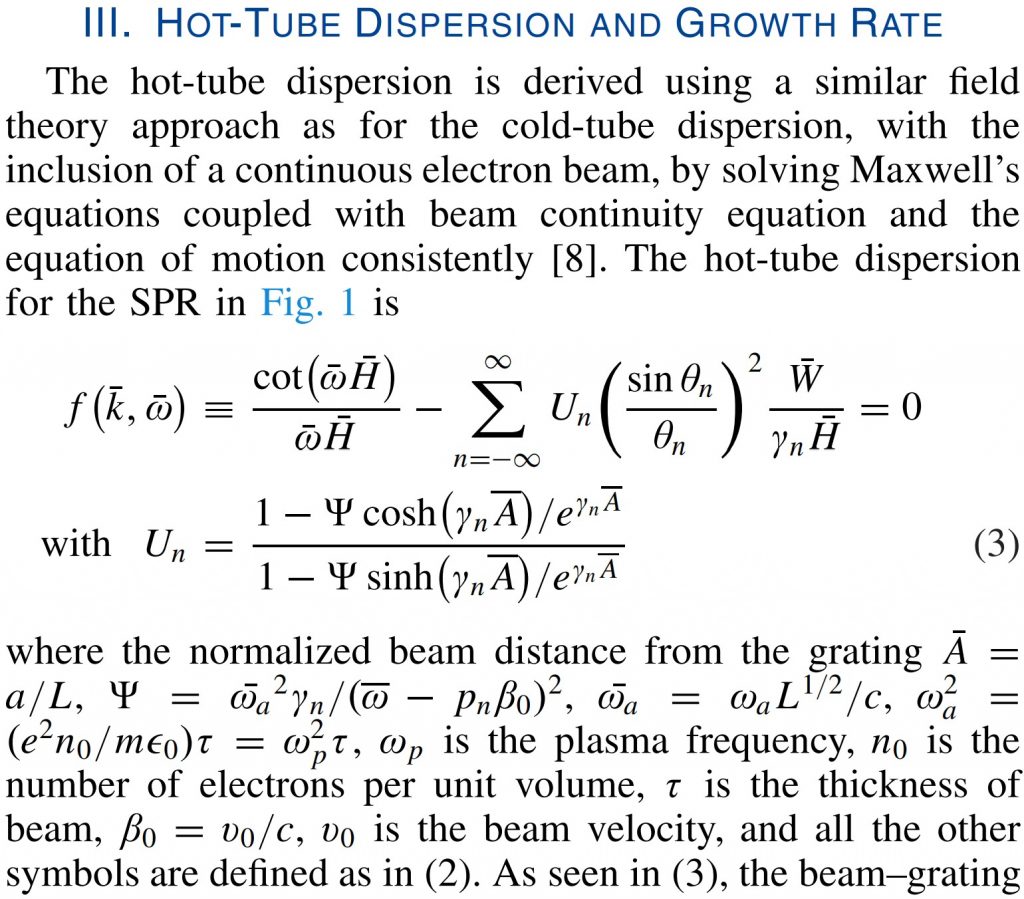
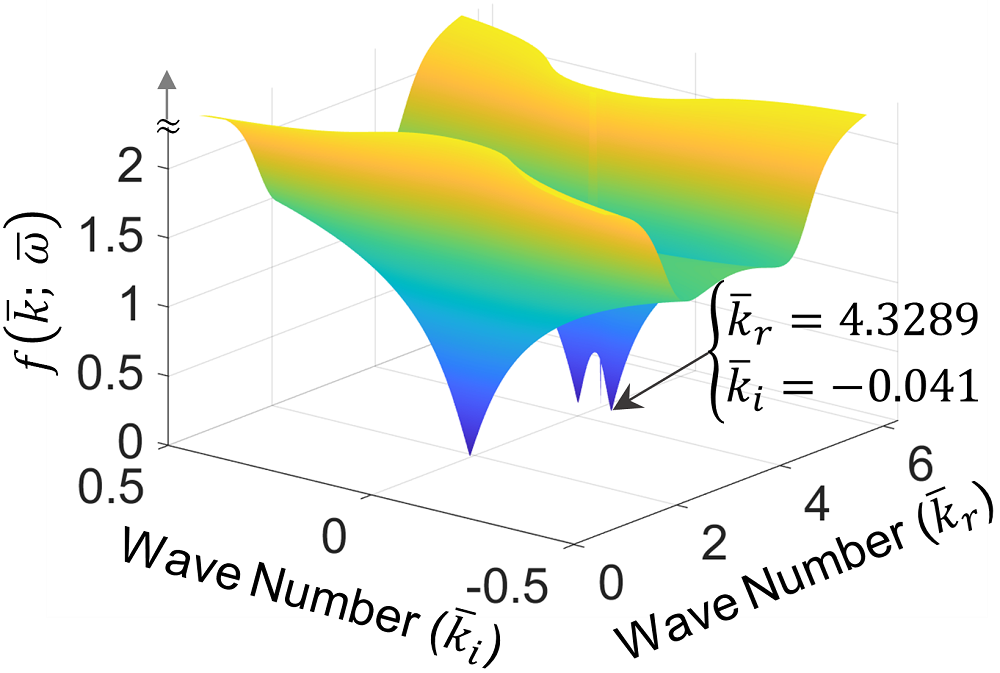
Fig. 4. The roots of the Eqn. (3) where the grating parameters are w = 60 μm and h = 40 μm and the corresponding operating frequency ¯ω = 1.80444 (cf. Fig. 2(a)).
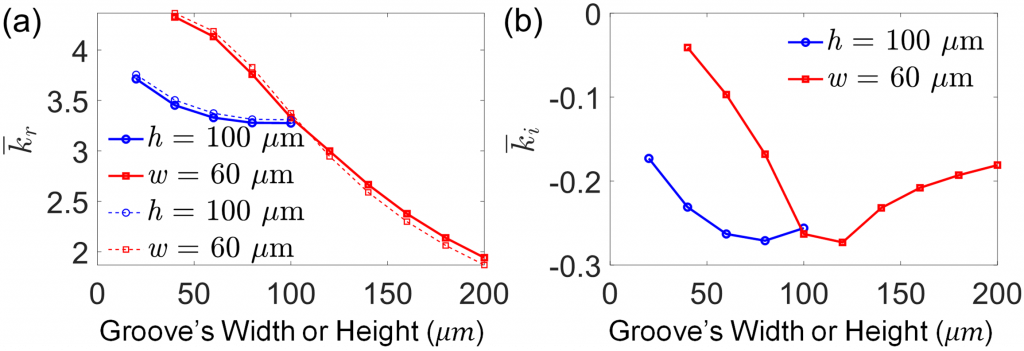
Fig. 5. (a) Real and (b) imaginary part of the wavenumber at the operating frequency ¯ω =2πf_ev L/c determined from Eqn. (2), as a function of the groove height h (squares, groove width w fixed at 60 μm) as well as groove width w (rounds, h fixed at 100 μm), calculated from the hot dispersion relation Eqn. (3). Dashed lines in (a) are for the wavenumber at f_ev calculated from the cold-tube dispersion Eqn. (2). The other parameters are kept as the same as in Table I.
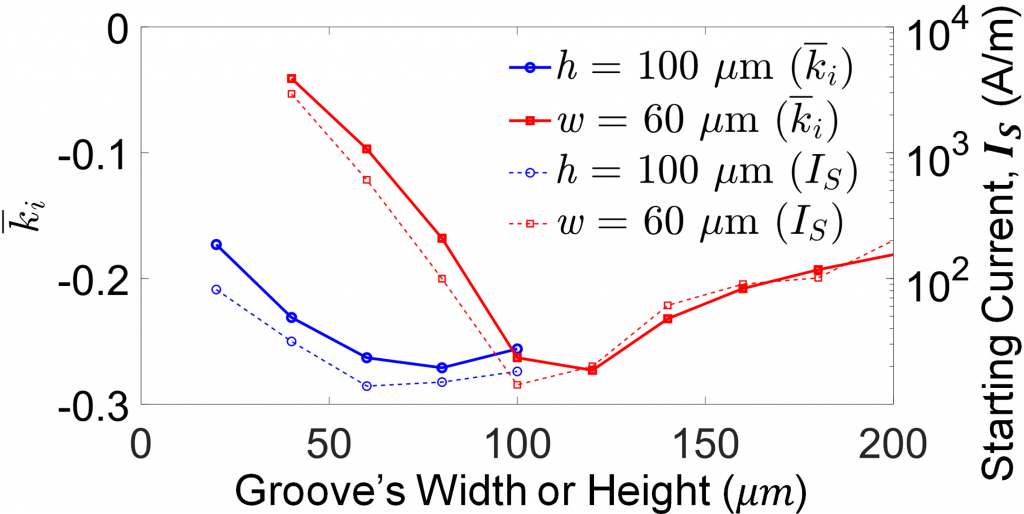
Fig. 5. Imaginary part of wavenumbers and the corresponding starting current values obtained from PIC simulations [3] as a function of the groove height h (squares, groove width w fixed at 60 μm) as well as groove width w (rounds, groove height h fixed at 100 μm). The other parameters are given in Table I.
Conclusion
In summary, we analyse SPR operation frequency and growth rate using the cold-tube and hot-tube dispersion relation. We systematically show how the operating frequencies of SPR have changed with different grating parameters using cold-tube dispersion relations where the grating period has been fixed. We demonstrate the spatial growth rate of SPR calculated from the hot-tube dispersion relation has the same scaling dependence on the grating parameters as the starting current calculated from PIC simulations. Thus, we confirm that the grow rate calculation using hot-tube dispersion relation can be used to predict the optimal grating parameters to minimize the starting current of SPR.
This approach has a significantly reduced computation cost compared to either direct PIC simulations or the traditional Johnson’s approach using BWO condition of zero-drive instability [24]. As both the operation frequency of SPR and its growth rate depend strongly on the grating parameters, both the cold-tube and hot-tube dispersion relations can be used in combination to minimize the starting current at a desired radiation frequency. While we apply our analysis to the effects of grating parameters on SPR, we expect our dispersion relation treatment to grating optimization is applicable to study linear free-electron beam based vacuum devices in general, and in various geometries (e.g. cylindrical geometry).
Note: Reproduction and redistribution of the figures in this article require permission from the authors.